
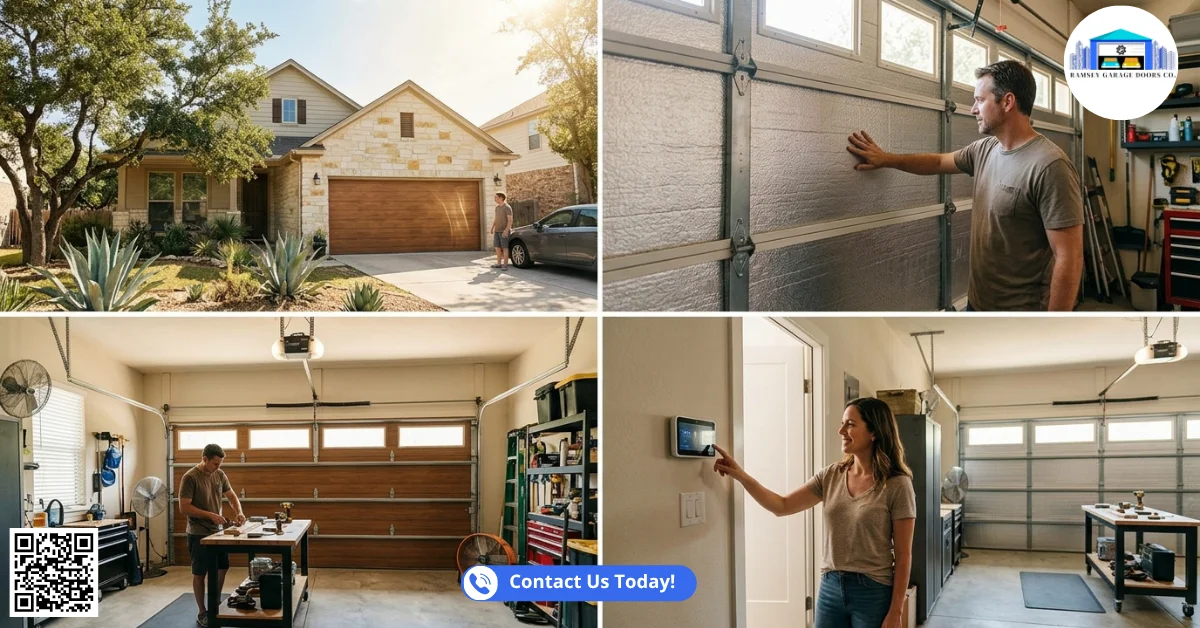

If you live in Central Texas, you know how punishing the weather can be. Summers in Austin regularly bring weeks of triple-digit heat, while sudden winter freezes can drop temperatures below freezing overnight. For most homes, the garage is the single largest opening in the entire structure. When that huge door consists of a thin sheet of uninsulated steel, it acts like a giant radiator baking your home in July and an icebox chilling it in January.
Over the past 15 years as a professional garage door technician in Austin, I have stepped into thousands of garages. On a 100°F day in August, an uninsulated garage door can reach interior surface temperatures of 130°F or more. That heat does not just sit in the garage—it bleeds directly into adjacent living spaces, forces your central air conditioner to work overtime, and turns a functional workspace into a sauna.
That is why smart local homeowners are upgrading to high-performance insulated models. In this comprehensive guide, we will break down the science of garage door insulation, examine how it protects your home from Central Texas weather extremes, and walk you through everything you need to know about professional insulated garage door installation Austin TX.
The Central Texas Climate Challenge: Heat, Humidity, and Thermal Bridging
To understand why an insulated garage door is so crucial in Austin, you first need to understand how heat moves through a residential building. Heat always moves from warmer areas to cooler areas through three primary mechanisms: conduction, convection, and radiation.
HEAT TRANSFER IN AN UNINSULATED GARAGE
Radiant Solar Heat (100°F+ Sun)
|
v
[ Thin Steel Garage Door ] ---> Reaches 130°F via Conduction
|
v
[ Trapped Garage Air ] --------> Superheats air to 110°F+ via Convective Loop
|
v
[ Adjacent Wall / Ceiling ] --> Heat Conduction into Air-Conditioned Living Spaces
When radiant heat from the Texas sun hits a standard uninsulated steel door, the metal conducts that heat straight to the interior face. That hot metal surface then radiates heat into the air trapped inside your garage. This creates a massive thermal bridge attached directly to your home's thermal envelope.
The Impact on Attached Living Spaces
Most modern Austin homes feature attached garages with bedrooms, bonus rooms, or kitchens sitting directly beside or above them. When the garage superheats to 110°F or higher:
- Heat Transfers Through Shared Walls: Drywall and standard fiberglass wall insulation can only resist heat flow for so long. Heat slowly transfers through shared framing into adjacent rooms.
- Floors Become Warm: Bedrooms located directly above an uninsulated garage often suffer from warm floors during summer afternoons, making HVAC systems work much harder to keep upstairs spaces cool.
- HVAC Systems Under Pressure: Your home's HVAC system must run continuously to combat the thermal pressure coming from the garage, leading to higher electricity bills and premature system wear.
The Sudden Freeze Hazard
While heat is the primary concern in Austin, winter storms have made cold weather resistance equally vital. Uninsulated steel offers zero protection against freezing winds. Any water lines, water heaters, or sensitive items stored in your garage become highly vulnerable when ambient temperatures plummet.
Understanding R-Value and Insulation Materials
When shopping for an insulated garage door, the most important metric you will encounter is R-value. R-value measures a material's thermal resistance to heat flow. The higher the R-value, the better the material insulates.
R-VALUE & INSULATION COMPARISON
[ Uninsulated Single-Layer Steel ] ==> R-1 to R-2
-----------------------------------------------------------------------------
[ Polystyrene (Styrofoam Vinyl-Backed) ] ===> R-6 to R-9
-----------------------------------------------------------------------------
[ Polyurethane (Injected Foam Sandwich) ] ======> R-12 to R-18+
However, not all insulated doors are constructed the same way. The two primary types of insulation used in modern garage doors are Polystyrene and Polyurethane.
1. Polystyrene Insulation (Vinyl-Backed or Steel-Backed)
Polystyrene is a rigid foam board similar to the material used in disposable foam coolers. In double-layer doors, pre-cut panels of polystyrene are inserted into the steel sections of the door frame and held in place by a vinyl backer. In basic three-layer doors, the polystyrene is sandwiched between two sheets of steel.
- Average R-Value: R-6 to R-9
- Pros: Budget-friendly, lightweight, provides basic thermal resistance.
- Cons: Leaves small air gaps along the edges of the door frame, lower structural rigidity than polyurethane.
2. Polyurethane Insulation (Injected Continuous Foam)
Polyurethane is a high-density liquid foam injected directly between inner and outer steel skins during manufacturing. As the liquid expands, it bonds tightly to every interior wall, filling every cavity, corner, and rib.
- Average R-Value: R-12 to R-18+
- Pros: Exceptional thermal performance, superior acoustic dampening, incredible structural strength.
- Cons: Higher initial investment.
Feature / Metric | Uninsulated Steel | Polystyrene (Vinyl-Backed) | Polyurethane (Sandwich) |
Typical R-Value | R-1.0 to R-1.5 | R-6.0 to R-9.0 | R-12.0 to R-18.4 |
Door Construction | Single Layer (Steel) | Double Layer (Steel + Foam) | Triple Layer (Steel + Foam + Steel) |
Noise Reduction | Minimal | Moderate | High (Up to 75% reduction) |
Dent Resistance | Low (Flexes easily) | Moderate | High (Solid composite structure) |
Best For | Detached non-heated sheds | Budget-conscious garage updates | Attached garages, conditioned spaces |
5 Major Benefits of Upgrading to an Insulated Garage Door in Austin
Investing in a quality insulated door offers long-term benefits that extend far beyond simple temperature regulation.
KEY BENEFIT OVERVIEW
[ Energy Savings ] -------> Reduces HVAC load on shared walls
[ Sound Dampening ] ------> Blocks street & lawn equipment noise
[ Structural Strength ] --> Dents less, withstands storm winds
[ Gear Protection ] -----> Extends lifespan of opener & springs
[ Usable Space ] --------> Turns garage into year-round shop/gym
1. Substantial Energy Savings
By stopping thermal radiation at the outer boundary of your home, an insulated garage door can lower interior garage temperatures by 20°F to 25°F during peak summer heat. This thermal buffer reduces heat transfer into adjacent living areas, directly lowering monthly electricity costs during summer months.
2. Outstanding Sound Dampening
City traffic, neighborhood construction, and morning lawnmowers can easily penetrate hollow single-layer steel doors. High-density polyurethane acts as a dense sound barrier, dampening incoming noise levels by up to 75%. Additionally, triple-layer insulated doors operate much quieter than hollow doors because the solid foam core absorbs operational vibrations.
3. Increased Structural Rigidity and Dent Resistance
In a suburban environment, garage doors regularly face impacts from stray basketballs, lawn tools, and backing vehicles. Uninsulated steel flexes easily and leaves unsightly dents. Polyurethane-injected doors create a rigid "sandwich" panel structure that resists denting, twisting, and wind-loading pressure far better than single-layer steel.
4. Extended Lifespan for Moving Parts
Extreme heat accelerates lubricant breakdown on garage door rollers, hinges, and springs, while extreme temperature fluctuations cause metal tracks to expand and contract. By maintaining a stable internal climate, an insulated door protects your garage door opener motor, logic board, springs, and bearings from premature failure.
5. Creation of Functional, Usable Garage Space
Whether you want to set up a home workout area, build a woodworking shop, or protect sensitive electronics and classic cars, an insulated garage door creates a controlled environment that makes your garage usable year-round.
Technical Comparison: Layer Construction Explored
When choosing an insulated door, garage door manufacturers group models into three primary categories: Single-Layer, Double-Layer, and Triple-Layer.
DOOR CONSTRUCTION TYPES
SINGLE-LAYER (1-Layer) DOUBLE-LAYER (2-Layer) TRIPLE-LAYER (3-Layer)
[ Steel Exterior ] [ Steel Exterior ] [ Steel Exterior ]
[ Foam Insulation ] [ Polyurethane Core ]
[ Steel Interior Backer ]
Single-Layer Doors (Pan Doors)
- Structure: Single sheet of stamped steel with exposed interior steel ribbing.
- Insulation: None.
- Performance: High heat transfer, loud operation, minimal dent resistance.
- Use Case: Detached garages or basic storage sheds where climate control is irrelevant.
Double-Layer Doors (Insulated Backed)
- Structure: Outer steel skin with exposed foam boards fitted into the interior panel cavities, backed by vinyl or thin foil.
- Insulation: Polystyrene panels.
- Performance: Moderate thermal barrier, quieter than single-layer doors.
- Use Case: Budget-conscious upgrades for attached garages that face away from direct afternoon sun.
Triple-Layer Doors (Sandwich Construction)
- Structure: Heavy-duty outer steel skin, injected polyurethane or dense polystyrene core, and a full inner steel backing sheet.
- Insulation: High-density injected polyurethane or thick polystyrene.
- Performance: Premium R-values (up to R-18.4), maximum structural rigidity, whisper-quiet operation.
- Use Case: Modern Austin homes with attached garages, room-above-garage layouts, or active garage workshops.
Technical Deep-Dive: Thermal Bridging, Seals, and Air Leakage
R-value alone does not tell the whole story of garage efficiency. A high R-value panel is useless if hot air leaks around the perimeter of the door frame. Air infiltration can completely negate the insulating power of a high-end garage door.
PERIMETER WEATHER SEALING SYSTEM
====================================================
| Header Weatherstripping |
|====================================================|
| | | |
Perimeter | | | | Perimeter
Side Seal | | Insulated Door Panel | | Side Seal
| | | |
|====================================================|
| U-Bottom Astragal Rubber Seal |
====================================================
Concrete Garage Apron
To achieve maximum energy efficiency, your installation must address three critical sealing components:
- Section Joint Seals: The horizontal connections between individual door panels must feature thermal breaks and flexible rubber seals to prevent air leakage when the door is closed.
- Perimeter Weatherstripping: Durable PVC weatherstripping with flexible vinyl lips must be installed along the top header and side jambs, creating a tight seal against exterior air infiltration.
- Bottom Astragal Seal: A flexible U-shaped rubber bottom seal must conform to uneven concrete aprons to block heat, dust, moisture, and pests from creeping under the door.
Step-by-Step Installation Process: What Real Technical Expertise Looks Like
Installing an insulated garage door requires specialized skills, heavy lifting, and careful precision. Because insulated doors weigh significantly more than single-layer steel doors, spring tension and structural components must be carefully matched.
Here is how our certified technicians at Ramsey Garage Doors Co execute a professional insulated garage door installation Austin TX:
INSTALLATION FLOWCHART
[ Step 1: Inspection & Sizing ] ----> Verify opening, track clearance & header strength
[ Step 2: Safe Tear-Out ] ----------> Safely release spring tension & remove old sections
[ Step 3: Track Alignment ] --------> Install laser-leveled heavy-duty vertical tracks
[ Step 4: Panel Assembly ] ---------> Set section joints, heavy hinges & nylon rollers
[ Step 5: Torsion System ] ---------> Calibrate high-cycle springs matched to door weight
[ Step 6: Opener Calibration ] -----> Adjust force limits & auto-reverse safety sensors
Step 1: Opening Inspection and Structural Verification
Before installing a heavier insulated door, we inspect the door frame, wooden jambs, and overhead header to ensure they can support the additional weight. We also take precise measurements of headroom, side room, and backroom depth.
Step 2: Safe Deconstruction and Removal
Garage door torsion springs store dangerous levels of kinetic energy. Our technicians safely unwind existing torsion or extension springs using hardened steel winding bars, dismantle the old door panels section by section, and recycle the old steel components.
Step 3: Track Set-Up and Laser Leveling
We install heavy-duty 14-gauge or 12-gauge vertical and horizontal steel tracks. Using precision levels, we ensure the tracks are plumb, parallel, and properly pitched so the door glides smoothly without binding.
Step 4: Section Assembly and Hardware Installation
The bottom panel section is carefully leveled on the concrete apron. We install heavy-duty commercial-grade bottom brackets, nylon-coated ball-bearing rollers, and reinforced steel hinges. Each subsequent panel section is stacked, secured, and aligned with precision joint seals.
Step 5: Precision Torsion Spring Engineering and Winding
Because insulated doors are heavier, standard lightweight springs will fail prematurely. We engineer custom-matched high-cycle torsion springs rated for 20,000 to 30,000 cycles. The springs are mounted on a heavy-duty steel shaft and wound to the precise number of turns required to perfectly balance the door's total weight.
Step 6: Opener Integration and Safety Calibration
Once the door is perfectly balanced by hand—meaning it stays in place when lifted halfway up—we connect it to the automatic garage door opener. We recalibrate travel limits, safety force thresholds, and infrared auto-reverse safety sensors to meet all safety standards.
Real-World Troubleshooting Scenarios for Austin Homeowners
Even high-quality insulated doors can encounter issues if neglected or installed incorrectly. Here are three common real-world scenarios our technicians encounter in the field, along with their professional diagnoses and solutions.
Scenario 1: "My new insulated door closes almost all the way, then reverses back up."
- The Root Cause: High-density insulated doors weigh substantially more than old single-layer doors. If an installer fails to upgrade the torsion springs or adjust the force limits on the opener motor, the opener's internal safety logic interprets the added weight as an obstruction and reverses the door.
- The Fix: A technician must verify the physical balance of the door by disconnecting the manual trolley release. If the door feels heavy or falls quickly, the torsion springs need additional winding turns or must be replaced with correct weight-matched springs. Once balanced, the opener's travel force limits should be recalibrated.
Scenario 2: "Water leaks into my garage under the corners of the door during heavy rain."
- The Root Cause: Austin's heavy downpours can push water under garage doors if the concrete slab has settled or if the bottom weather seal has hardened and cracked over time.
- The Fix: Replace the worn seal with an oversized, commercial-grade EPDM rubber bottom seal. If the concrete apron is pitted or uneven, installing an aluminum threshold track glued directly to the floor creates a watertight barrier that stops wind-driven rain.
EPDM BOTTOM SEAL & THRESHOLD PROFILE
[ Insulated Door Bottom Section ]
||
/==================||==================\
| Oversized EPDM Rubber Bottom Seal |
\======================================/
====================================================== <--- Concrete Apron
[ Raised Aluminum Threshold ]
Scenario 3: "The garage door operates with a loud popping or grinding noise."
- The Root Cause: Heat expansion during Texas summers can cause steel track sections to shift slightly out of alignment. Additionally, cheap plastic rollers can bind inside the tracks, placing extra strain on the motor.
- The Fix: Re-align and tighten all track mounting brackets. Upgrade old steel or plastic rollers to sealed 13-ball-bearing nylon rollers, which reduce noise and operate smoothly without requiring regular messy greasing.
Essential Maintenance Practices for Texas Garage Doors
To maximize energy efficiency and extend the lifespan of your garage door, perform these simple maintenance tasks twice a year:
SEMI-ANNUAL MAINTENANCE CHECKLIST
[ Clean Weatherstripping ] -> Wipe down PVC side/top seals with silicone spray
[ Inspect Bottom Astragal ] -> Check rubber bottom seal for cracks, gaps, or dry rot
[ Lubricate Hardware ] ------> Apply synthetic lubricant to hinges, rollers & bearings
[ Test Balance ] -----------> Disconnect opener & lift door halfway to check balance
[ Clean Photo Eyes ] -------> Wipe dust & cobwebs off safety sensors for reliable function
Condition Perimeter Seals: Extreme sun and heat can dry out PVC weather seals, causing them to crack and crumble. Spray silicone lubricant onto perimeter weatherstripping twice a year to keep the rubber soft and flexible.- Lubricate Moving Hardware: Apply a light coat of synthetic garage door lubricant to steel hinges, roller shafts, and torsion springs. Never use WD-40 or heavy axle grease, as they attract dirt, dust, and grit that can grind down moving parts.
- Verify Balance Annually: Pull the emergency release cord to disconnect the door from the opener motor. Manually lift the door to waist height and let go. If the door stays in place, your springs are balanced. If it crashes down or shoots upward, call a professional technician to adjust spring tension immediately.
For complete federal safety guidelines regarding residential automatic garage door systems, consult the official standards published by the U.S. Consumer Product Safety Commission.
Aesthetic Styles to Complement Austin Architecture
Insulated doors do not force you to compromise on curb appeal. Modern manufacturing allows high R-value insulation to be built into virtually any architectural design:
AUSTIN ARCHITECTURAL DOOR MATCHING
[ Modern & Contemporary ] ----> Flush panels with frosted full-view glass accents
[ Hill Country Craftsman ] ---> Carriage house paneling with decorative hardware
[ Traditional Suburban ] -----> Classic raised-panel steel with insulated window inserts
Modern & Contemporary: Smooth, flush-panel polyurethane doors with vertical side windows and sleek powder-coated finishes perfectly complement modern East Austin builds and contemporary Hill Country homes.- Hill Country Craftsman: Carriage-house style insulated steel doors featuring faux-wood composite overlays provide the warm look of natural wood without the warping, splitting, and high maintenance demands caused by humidity.
- Traditional Suburban: Classic raised-panel or recessed-panel designs with insulated glass window inserts add timeless appeal to homes in neighborhoods like Allandale, Crestview, and Hyde Park.
To learn more about local building energy codes and efficiency standards for residential remodeling in Central Texas, visit the official City of Austin Energy Code Resources.
Cost vs. Long-Term Value: A Smart Investment for Austin Homeowners
While a high-performance insulated garage door carries a higher upfront cost than a basic single-layer door, the long-term return on investment (ROI) makes it one of the most cost-effective home improvements available.
According to national remodeling data published annually by Remodeling Magazine, garage door replacement consistently ranks among the top home improvement projects for return on investment at resale, frequently recovering over 90% to 100% of its cost upon home sale.
Financial Breakdown: Upfront Cost vs. Long-Term Savings
FINANCIAL COMPARISON
BASIC SINGLE-LAYER STEEL TRIPLE-LAYER POLYURETHANE
------------------------ -------------------------
Initial Cost: Low Initial Cost: Moderate-High
R-Value: R-1 to R-2 R-Value: R-12 to R-18+
HVAC Impact: High Energy Waste HVAC Impact: Noticeable Power Savings
Longevity: 5-8 Years (Dents Easily) Longevity: 15-20+ Years (Heavy Duty)
Resale ROI: Basic Value Resale ROI: 90%+ Recaptured at Sale
When you factor in reduced monthly cooling costs, longer HVAC equipment lifespan, added usable garage square footage, and improved curb appeal, an insulated door quickly pays for itself.
Frequently Asked Questions (FAQs)
What is the ideal R-value for a garage door in Austin's climate?
For attached garages in Central Texas, an R-value between R-12 and R-16 provides optimal thermal protection against extreme summer heat. Higher R-values are especially beneficial if you have a bedroom directly above the garage or use the space as a climate-controlled workshop.
Will installing an insulated garage door lower my home insurance premium?
Certain insurance providers offer discounts for upgrading to heavy-duty multi-layer insulated garage doors because they offer superior structural strength against severe windstorms. You should check with your local insurance agent to see if your new door qualifies for wind-resistance discounts.
Can I add aftermarket insulation panels to my existing standard steel garage door?
While DIY insulation kits are available, adding heavy foam boards to a door designed for lightweight single-layer steel alters its balance and overloads the torsion springs. This extra weight can cause the springs to snap prematurely and damage your garage door opener motor.
How long does a professional insulated garage door installation take?
A standard residential insulated garage door installation typically takes a crew of experienced technicians between three to five hours to complete. This timeframe includes removing the old door, assembling the new panels, installing fresh tracks and springs, and fully calibrating the opener system.
Final Thoughts
Living comfortably in Austin means making smart choices about home energy efficiency. An uninsulated garage door is a massive thermal vulnerability that drives up cooling bills, subjects adjacent living spaces to harsh outdoor temperatures, and leaves your home exposed during severe weather events.
Upgrading to a high-density, multi-layer insulated door transforms your garage into a comfortable, quiet, and energy-efficient space. By stopping radiant heat before it enters your home, you will protect your HVAC system, lower monthly utility costs, and add long-lasting value and curb appeal to your property.
How Can Ramsey Garage Doors Co Help You?
If you are ready to upgrade your home's comfort, curb appeal, and energy efficiency, the expert team at Ramsey Garage Doors Co is here to help. With 15 years of dedicated field experience serving Austin and the surrounding Central Texas communities, we specialize in high-performance insulated garage door installation Austin TX.
Our certified technicians handle every step of the process—from helping you select the perfect architectural style and R-value to performing precision spring engineering and seamless track installations. We treat your home with the care and attention to detail it deserves.
Contact our friendly local team today to schedule your on-site consultation and get a free quote on your garage door upgrade!
Ramsey Garage Doors Co
📍 Address: 5502 Burnet Rd, Austin, TX 78756
📞 Phone: (512) 675-6884
